Hidetaka Niiyama Conductor 新山英隆 指揮者 東京

Conductor Hidetaka Niiyama

指揮者 新山英隆公式サイト

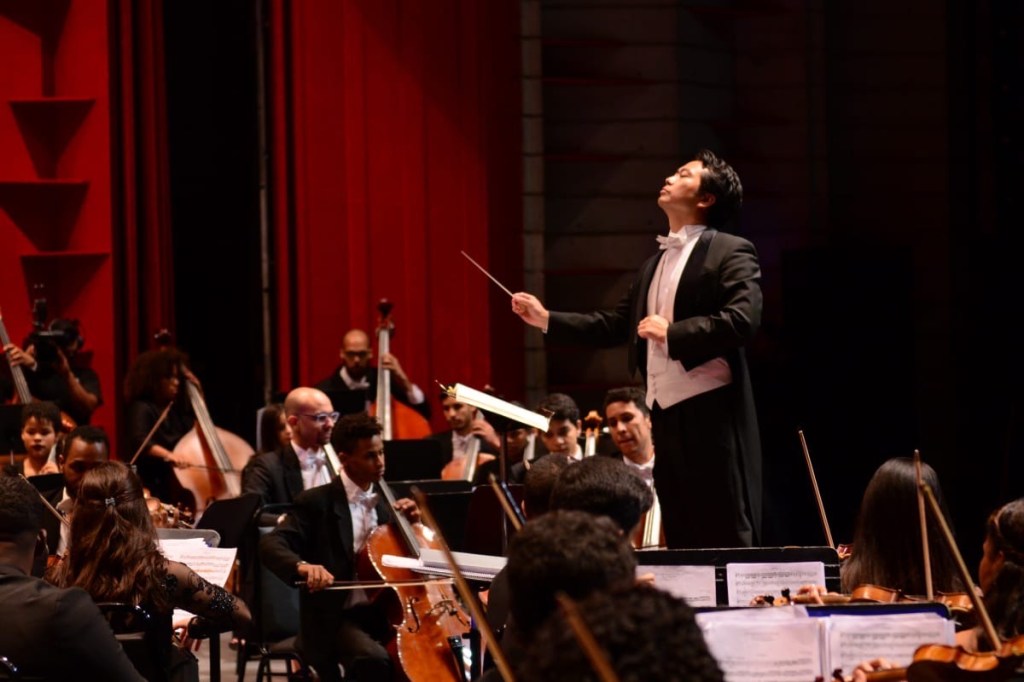
Tokyo Sinfonia, Oji Hall, Tokyo, Japan 

  • I was assisting October Concert for Tokyo Sinfonia.  Mr. Amit Peled, an acclaimed cellist, a professor in Peabody Conservatory, played two romantic concertos, Schumann and Dvorak.  Amit played so beautifully and convincingly and as soon as he started to play in our rehearsal, the we all knew we were facing with a world class musician.  Wow wow.  His concertos were so impressive and the concert went so well. Dvorak is not easy for conductors, as there are in a way, lots of communication back and forth, especially in the second and third movement.  I enjoyed watching two world class musicians working together.

    Just a side note, but two days before the concert, I was informed that I would be conducting a piece in the concert.  I, a bit shocked, but quickly realized that I left my tail coat in my home and I have to go back to bring it.  When I opened my bag up, yes, I could fit in the tail, but I would need a vest and a white shirt.  I had to go to Aoki in Ginza and Sogo in Chiba to get all that I needed. Tokyo has everything.

    Let me talk about a bit about Manfred.  A British poet, Lord Byron made this strange play based on a man who exiled to mountains in Alps and start talking to spirits about his past and present.  It reminded me of 80s film “Shining”.  Recently, I had to conduct Brahm’s Serenade and I read a lot about his relationship with Schumann family.  It is a tragic one and it’s sad how Schumann passed away, but I do believe Schumann was a fantastic composer.  I never felt so good to conduct emotionally complicated piece.  I cannot wait to conduct his other works in the near future.

    Musically speaking…there is what I call Manfred theme. It’s symcopated block chords. Then it moves to a slow introduction. I tried to make it as spooky and cold as possible, very much like feel in Alps I imagined. Then, slowly, the introduction speeds up to Manfred theme, speed up about six times faster than originally started. Once music goes into allegro, several theme with different charcters are played. I changed tempos slightly, so it depicts the mood. In the middle section, music dies down all the way to pianissimo. But, you know it goes wild from then on! I added extra spice into cello and viola solis and it worked good. The music ends with the slow introduction with reminecense of themes you heard in the allegro section. It ends quietly.

    Here is a video for our performance.  Enjoy!

    https://www.instagram.com/niiyama_conductor

  • 出身地は? / 地元のマイルールは?

    千葉市。昔は、何もすることないと海行くべとなった。

    休日は何をして過ごすことが多い?

    プレミアリーグで鎌田選手を観る。今は日本人選手が多いのでチェック。

    最近ハマっていること(沼)は?

    道の駅で新鮮な野菜のお買い物

    今、一番行きたい場所や国は?

    イタリア、オルビエート、オペラ修行した時の留学先

    自分の性格を漢字一文字で表すと?

    笑

    もしペットを飼うなら、どんな動物?

    豆柴。猫5匹飼ってるけど。現実味はない。

    自分を動物に例えると何?

    猫。

    1日だけ誰かに(有名人や架空のキャラ)になれるなら誰?

    スーパーマン、空を体だけで飛んでみたい。

    子供の頃の夢は? 今とのギャップはある?

    サッカー選手。幼い頃に市船の選手を見て無理とわかりました。

    これまでで「一番テンションが上がった出来事」は?

    やっぱりイタリアでオペラの指揮をした時かな。

    人生で一番感動した本、映画、または出来事は?

    色々あるけど、東野圭吾さんの小説は好き。

    譲れないこだわり(マイルール)はある?

    洗濯。

    宝くじで1億円当たったら最初に何をする?

    オーケストラを超田舎に作る。

    タイムマシンが1回使えたら、過去と未来どっちに行く?

    過去。シューマンと坂本龍馬には会いたい。

    あだ名?

    ヒデさん、23(にーさんだから。)

    見た目とギャップ?

    音楽的には繊細。

    地元ネタ?

    ちば大好き。ジャガーさん。チーバくん。ふなっしー。BayFMが聴ける環境があれば、人生やっていけると思う。

    部活動?

    小中サッカー部。高校で吹奏楽部。

    苦手なもの?

    漢字。梅干し。

    ちょっとした特技?

    百人一首。中学で全校で一位。

    家族ネタ?

    アメリカ人の妻と結婚して20年以上。家では英語。

    死ぬまでにやりたいこと?

    マーラーの交響曲。2とか9とか。

    https://www.instagram.com/niiyama_conductor

  • I recently attended 10 day long workshop for emerging and professional workshop provided by Robert Ryker and Tokyo Sinfonia.  I have so many good things to say and I wanted to share my experience in my post.

    Three other conductors and Maestro met everyday for lunch and we hD rehearsals almost every other day.  During lunch, we discussed the various topics of being a professional conductor such as rehearsal technique, rehearsal scheduling, educational programming, communication with orchestra, etc.  Maestro Ryker was a former Principal Tubist for Montreal Symphony Orchestra when Zubin Mehta was conducting.  So, he had insight of how professional orchestras ran.  Also, having managed and conducted Tokyo Sinfonia for more than 20 years, he had a lot to say about making the orchestra attractive for the audience in Tokyo area.  He encouraged every conductor to start a sting orchestra.

    At a glance, in Tokyo Sinfonia’s rehearsal, you see predominantly female musicians.  I found only two male players out of 19 piece string orchestra.  The orchestra provides friendly environment for working mothers, as it seems.  Many of them plays with the orchestra since the beginning of the orchestra 20 years ago.  Also, it seems that the musicians own parts of the orchestral management such as contracting and time management.  My impression was this orchestra is women powered and women run orchestra.  

    Also, Tokyo Sinfonia challenges themselves to higher artistic excellence by having each player play like a soloist.  Robert’s (with respect, as Maestro prefers to be called by his first name) philosophy is that every player should play like a soloist and he makes arrangements for 19 piece orchestra.  In other words, instead of mainly 5 parts in the string orchestra, there are 19 parts in the orchestra.  Nobody can play behind someone, in other words.  He also assigns each player to be a soloist in their regular orchestra season, so each player has to continue to keep their skills up.

    To be continued

    https://www.instagram.com/niiyama_conductor

  • Memorization

    Do you memorize the entire score, or are you reading everything on the podium?

    To me, a musical score is like a map.  Sometimes I need to memorize the entire score because I am conducting a really fast tempo and I cannot simply turn pages every second.  The beginning of the La Boheme, Puccini’s opera calls for memorization for sure. This is very much like I cannot look up google map while I am riding a bicycle in fast pace in mountains.  

    If I am conducting music that I am very familiar with, maybe I listened to it as I was growing up or conducted many times, then I don’t need a score.  This is very much like you don’t need a map when you go back to see your grandmother.

    Practically speaking, it’s good to memorize a piece.  It gives you freedom as a conductor.  It gives you a chance to have eye contact with musicians, you can use all of your hands for expressions, you can keep showing your faces to express mood and other important elements of music making.  If you are buried in the score, orchestra members cannot tell what your music directions are.

    But, memorizing entire scores come with experience. It’s not very easy to memorize a piece if you are not familiar with a composer’s language.  For example, going back to a map analogy, if you are to visit a medieval city in the Southern Italy, can you memorize the town map easily?  Can you remember where the Cathedral is?  Where are the churches?  Where are cafes?  It’s not that easy.  Is it? On the other hand, can you memorize a map of Manhattan?, say you are going to Madison Square Garden from Carnegie Hall. Probably, a bit easier!  It’s is easier because you know many landmarks and also roads are numbered!  You probably know where the Central Park is and your favorite restaurants are.

    Just because we, conductors read a score on the podium doesn’t mean we don’t have it memorized. We discover new things when we conduct and listen to the orchestra while reading the score. It’s very much like looking at a treasure map while you are searching for a gate that leads to the treasure and you find river and bridges along the way on the map. We discover new things as we conduct with the score.

    To memorize the piece of music, we need to be familiar with a composer’s towns, so to speak.  How does a composer use their instruments, harmony, melodies, rhythms etc.  So, let’s visit their towns, i.e. listen to their music, so you can memorize a score a little better!

    https://www.instagram.com/niiyama_conductor

  • What does a conductor do?

    What do we do?  The short answer is waiving hands. But, there is much more to it.

    I have not conducted in Japan professionally until recently and my nephews came to my concert for the first time last August.  It was with Tokyo Sinfonia in Ginza Oji Hall and I conducted Brahms’ Serenade No. 2.  What the eldest nephew told me was that he was surprised to see how I changed a shape and size of the motions based on the music I was conducting.  I never thought it that way, but it’s true, we as a conductor change the size of the shape depending on the music.

    So, what do we do?

    I have been to a rehearsal where a great conductor conducted the orchestra and one of the most memorable rehearsal was by James DePriest.  He was guest-conducting Indiana University Symphony Orchestra when I was a Master student in 2004 and luckily I was assigned to assist his concert.  He was conducting Mozart’s Symphony No. 38 in D Major.  It’s got only three movements in this symphony, not four.

    He was just there waiving hands, but the sound that came out of the orchestra was fresh, beautiful, elegant, anything that you would imagine genius Mozart intended the music to be.  I was literally floored as I learned that a conductor could change the sound of the orchestra, by simply standing in front of the orchestra and waving hands.

    I still don’t know how it happened, but then I learned that great conductors carry music on their shoulders.  Yeah, we simply waive hands, but there are lot more than that.  I wish I could explain better, but I have literally no words to describe the act.

    Here is a video by Mr. DePriest’s appearance in the Young People’s Concert by New York Philharmonic.

    https://www.instagram.com/niiyama_conductor

  • First time I ever conducted was when I was in junior highschool in Chiba, Japan, suburb of Tokyo.  As I was growing up in Japan in 1980s, 90s, each class room had to sing a song for a yearly singing competition.  Back then, our generation was probably like Dragon Ball Generation, or Generation X (unlike one in US) where there were so many babies born during the time.  1.6 million babies were born in Japan in the year of 1979.   (0.6 million babies were born in 2026.) 

    I remember my class room was Class E and there were classes up to H.  So, if they had 40 kids in each class room, ABCDEFGH, 320 kids in the year.  I was one of many suburb kids who was not paying attention to the class study and was playing soccer every chance I got.  I wasn’t very good at it, and I didn’t make a A team.  But, I enjoyed the soccer practice.

    One day, my class room teacher and music teacher asked me to conduct a class choir.  We were learning two pieces of music for a singing competition.  My classroom teacher said that if I conduct, bad classmates who were messing around in the back would join to sing.  I had that kind of leadership, I guess.  Until then, there was a smart girl who could play piano well was conducting the choir, and my friends were not paying attention.  They were messing hair and kicking other kids rear-end etc.  I had to manage the situation while I was in charge.  To be honest, I was good friends with the bad boys in the class, so all I had to do was to stare at them.  In short, I managed conducting a classroom just fine.  So, I probably made impression that when I conducted, everybody sang…

    The chorus piece I had to conduct was about aftermath of the Atomic Bomb in Hiroshima. It was a heavy and dark subject. I wonder if I can add a link here.  

    https://youtu.be/f33pjc3qA78?si=Br_fN3vqCCOp5o6U

    For me, if I listened to music for a few times, I could pretty much have it in my memory.  So, when I was picked to conduct, I already knew all the parts, for example, I could sing soprano, alto and tenor parts. I could tell who was breathing in wrong place, where the pitch gets bent, which key the grand piano in the music room is out and so on.  I was in Yamaha Music School with my sister in very young age.  We played music like a toy, like hey what pitch is this?  Can you sing this song etc.  My brother had me listen to so many western pop music, Van Halen, Metallica, Stevie Wonder, Beethoven, Simon and Garfunkel etc.  My sister was constantly listening and singing musicals, ballet music, oldies, and J-pop.  I absorbed them all.  I am guessing that my classroom teacher and music teacher could tell I had decent ears!

    After that, I was picked to conduct a graduation ceremony and then later I was picked to be a student conductor for a brass band in High School.  So, somehow, I was able to conduct for more than 3 decades!

    https://www.instagram.com/niiyama_conductor

  • Hello World!

    I am excited to launch a new website as niiyamamusic.com! Stay tuned for more information!

    https://www.instagram.com/niiyama_conductor